The interview was conducted on October 14th, transcribed the next day, and given to Jim on the 16th for editing; he removed some references to the trial which might have been considered legally damaging should he be found guilty and subsequently file an appeal. Salli remembers the interview, conducted at the Doors’ office, as being ‘very businesslike until we got to the Phone Booth’. After that it was ‘outrageous’, she says, but by then the tape recorder had been put away. The interview appeared in two installments, in December 1970 and January 1971, in Circus magazine.
It was almost four o'clock when Kurt Ingham (our photographer) and I met Risa, friend and PR girl, and sallied forth to see Jim for the first of what was to be roughly two days in the life of. The office, an ex-antique shop on Santa Monica Blvd., is California stucco browns and golds. The fact that it is perpetual dusk inside blinds you to the presence of a very quiet Jim, sans paunch, sitting in a corner behind a desk.
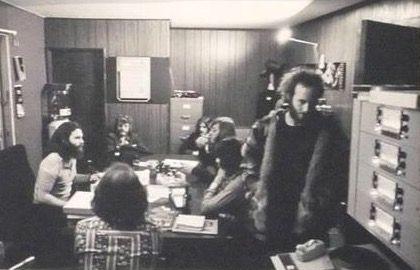
His smile is slow, genial, more in his eyes and in view of the ringing phones and takin' care of business voices he suggests that we try taping in the garden which features a minute pool with four frying sized gold fish, a distinct change from the lizards and snakes you half expect. Risa inquires after the crocodile only to find that that particular pool resident is late, great and gone which delights me no end. Lizards are passable, but crocs don't do much for my frazzled stomach and we are all just a bit edgy about confronting the 'Image'. Jim asks for a cigarette explaining that he only smokes when nervous.

SALLI STEVENSON: Your latest album has received some rather harsh criticism, not only because it was another live album among the many released, but because of the lack of polish attributed to it by many critics. How did it come about and why the seeming lack of practice?
JIM MORRISON: The Live album was condensed from about 24 hours of taped concerts that we did over approximately a year's period of time, starting with the Aquarius Theater in August 1969. We thought we might have one that night. We did two sets, but when we listened to it in the studio we found that it didn't really add up to a very good album. It was a good evening, but on tape it didn't sound that good. So we recorded seven or eight other concerts and listened to all of it and cut it down. I think it's a fairly true document of what the band sounds like on a fairly good night. It's not the best we can do and it's certainly not the worst. It's a true document of an above average evening. I like 'The Celebration', though it's not a great version of that piece, but I'm glad we went ahead and put it out, because I doubt if we would have ever put it on a record otherwise because it's a couple of years old. We tried to do it at the time we were doing Waiting For The Sun and it just didn't seem to make it in the studio, so we used one piece out of it, 'Not To Touch The Earth'.
If we hadn't put it on a live album, we would have just shelved it forever. I'm glad that we did it even in the imperfect form in which it exists. It's better than if we had never done it. As far as the lack of practice ... I think most of it is pretty professional. There are a few cuts that were done for the first time on stage, that we really hadn't worked with that much, that have flaws in them ... but I don't think it's significant. People don't realise how different playing live is from recording. You work for days to get an instrumental track and then work for hours to get a vocal. Of course in a live thing, it's just that one shot. Basically the music has gotten progressively better, tighter and more professional ... more interesting.
How then do you explain what appears to be a decline in your musical inventiveness over the last year or so? When you first started out, you were the great revolutionary hope of America and now the group seems to have mellowed.
JIM MORRISON: Three years ago, if you remember, there was a great renaissance of spirit and emotion tied up with revolutionary sentiment. When things didn't change overnight, I think people resented the fact that we were just still around doing good music. What about the deaths of Janis and Jimi. They went through the same period ... I think that that great creative burst of energy that happened three or four years ago was hard to sustain for the sensitive artists. I guess they might be dissatisfied with anything except 'the heights'. When reality stops fulfilling their inner visions, they get depressed.
RISA: How do you think you'll die?
JIM MORRISON: I hope at about age 120 with a sense of humour and a nice comfortable bed. I wouldn't want anybody around. I'd just want to drift quietly off, but I'm still holding out. I think it's very possible that science has a chance in our lifetime to conquer death. There are many people who believe in reincarnation and spirits. If medical science were to do that, what would happen to their spirit world? They'd just have to fend for themselves. Leave us poor immortals alone.
I take it you don't believe in Karma or reincarnation or the occult beliefs?
JIM MORRISON: No, not really, but since I don't have anything else to replace it with, I listen to everything. I don't say no.

What do you believe in then?
JIM MORRISON: We evolved from snakes and I used to see the universe as a mammoth peristaltic snake. I used to see all the people and objects and landscapes as little pictures on the facets of their skins. I think the peristaltic motion is the basic life movement and even your basic unicellular structures have this same motion. It's swallowing, digestion, the rhythms of sexual intercourse.
It's been said that you've been on a superstar, super-ego trip. Has this affected you or your friends, or your relations with the band?
JIM MORRISON: That's a complex one. Obviously you don't really talk about those things with people. I don't think it was that bad. I never noticed it too much except when I read magazine articles, but living in a town like L.A. you don't notice those images. People here are pretty blasé about things like that.
How about the magazines?
JIM MORRISON: Actually I've always liked the things I've read. Of course it was about me. Usually you are most interested in yourself and people that you know. But ... they were concentrating on my progenitive organ too much and weren't paying attention to the fact that I was a fairly healthy young male specimen who also had other than your usual arms, legs, ribs, thorax, eyes ... but a cerebellum ... your completely equipped human being with the head, sensitivity, the full equipment.
KURT: For a while there was a cycle in pop stardom where people look up to pop stars for their answers, forgetting that pop stars are people too. Now they seem to have come from idols to heroes. Using the definition that a hero is someone you can reach out to and an idol is someone unreachable, do you consider yourself an idol or a hero?
JIM MORRISON: A hero is someone who rebels or seems to rebel against the facts of existence and seems to conquer them. Obviously that can only work at moments. It can't be a lasting thing. That's not saying that people shouldn't keep trying to rebel against the facts of existence. Someday, who knows, we might conquer death, disease and war.
What about you, though ...
JIM MORRISON: I think of myself as an intelligent, sensitive human being with the soul of a clown, which always forces me to blow it at the most important moments.
If you had it to do over?
JIM MORRISON: I'm not denying that I've had a good time these last three or four years. I've met a lot of interesting people and seen things in a short space of time that I probably would not have run into in twenty years of living. I can't say that I regret it. If I had it to do over, I think I would have gone for the quiet, undemonstrative artist, plodding away in his own garden.
When you were at U.C.L.A., you were involved in theatre and with that background you joined a band. Have your visions for the band become a reality?
JIM MORRISON: Initially, I didn't start out to be a member of a band. I wanted to make films, write plays, books. When I found myself in a band, I wanted to bring some of these ideas into it. We never did much with it, though … it would take a long volume of prose to answer that with any degree of candour or truth. So, I think you're going to have to wait until I can get to work and write down what I really feel about that. It's too deep to cover in this amount of time and I wouldn't even want to give a short answer, because that's the most interesting question of all. I'm already working on it really, between interviews. I like interviews … it's similar to answering questions on a witness stand. It's that strange area where you try and pin down something that happened in the past and try honestly to remember what you were thinking about, what you were trying to do. It's a crucial mental exercise. An interview will often give you a chance to confront your mind with questions which to me is what art is all about. It's a form of self-interview in which you pose yourself questions and try to come up with a reasonable answer. An interview also gives you the chance to try and eliminate all of those space fillers. All they do is if you can't think of an accurate answer you just 'kind of, you know, ahh, what I mean'.
KURT: But everybody does it.
JIM MORRISON: I know. But you should not. Doctors, lawyers, scientists, good writers usually do. You'll notice that their conversation is much less vague than what you run up against with other people. It may be full of obscurities of its own kind, but you should try to be explicit, accurate, to the point … no bullshit. I like the interview form and I think it's going to become an increasingly important art form. It has antecedents in the confession box, debating and cross examination. Once you say something, you can't really retract it. It's too late. It's a very existential moment.
KURT: Have you seen Alice Cooper or the Stooges?
JIM MORRISON: I haven't heard them. I've just read a few things about them … sounds great. I like people that shake other people up and make them uncomfortable.
Speaking of being uncomfortable, what's happening with the trial?
JIM MORRISON: I had a six week trial and it was very interesting. The felony rap was dismissed and I'm still stuck with the two misdemeanours which could add up to eight months in jail. I'm admitting the charge of public profanity, but I'm denying the exposure charge. We're going to appeal that for as long as it takes to get it dismissed. It may take another year or two, I think it was more of a political than a sexual scandal. They picked on the erotic aspect, because there would have been no political charge they could have brought against me. It was too amorphous. I really think that it was a lifestyle that was on trial more than any specific incident. Anyway, I go back to court on October 30th.
[Editor's note: This interview was conducted a few days before the trial.]
JIM MORRISON: At that time there will be a sentence directed. The maximum would be eight months and a fine. However, whatever the sentence would be, even if it were suspended and there was a probation of some kind, we would still go ahead and appeal the conviction. The public profanity misdemeanour could be very easily dismissed because the Supreme Court has recently ruled that in a theatrical performance, not just theatrical performances, but in most other situations, the First Amendment guarantees freedom of expression. That conviction would automatically be held unconstitutional. On the exposure charge we're maintaining innocence. Since the prosecution didn't come up with any real proof, we'll just appeal it and take it to a higher court. So I wouldn't go to jail immediately ... I don't think. It was a very interesting trial. I'd never actually seen the judicial system in action, the progress of a trial from the first day to the last. Being the defendant I had to be there for every day and it was fascinating ... very educational. I wouldn't have chosen to have gone through the experience, but while it was happening all I could do was watch.
‘You are a person graced with a talent, admired by many of your peers. Man tends to imitate that which he admires and those gifted with the ability to lead and influence others should strive to bring out the best, and not the worst in his admirers.' With that speech, Judge Goodman meted out the sentence for profanity and indecent exposure. Jim received six months, almost the maximum, and his bail was raised from $5,000 to $50,000. He is appealing the charge which could take up to three years and if successful, it is certain that he will have to serve no time at all. If the appeal fails he will probably serve a maximum of two months.
JIM MORRISON: I was quite relieved that I wasn't taken into the jail and booked. They could have done it easily. I feel quite free for the first time in a year and a half. We're going to fight the sentence until it is wiped clean off the records. The appeal motion will first have to go to the Circuit Court in Florida and if it doesn't pass muster there, it will go to the State Court and eventually to the Supreme Court. If they accept it, there will be a final decision then.
On what factors is the appeal to be based?
JIM MORRISON: The judge's attitude seemed to be that he was trying to prosecute me to the limits of the law. That will be one of our appeals, that I didn't really receive a fair trial because of judicial prejudice. For example, he limited the defense witnesses to the exact number that the prosecution had and he would allow no evidence regarding the contemporary community standards as, for example, taking the jury to see Woodstock and Hair and other current movies and plays that were showing in Miami at the time. These were two examples of his rigidity and lack of fairness in our opinion. The big charge, which was indecent exposure, was not conclusively proven in six weeks of testimony. There were ten to twelve thousand people there at the performance and countless cameras. The prosecution was not able to come up with one picture, one photograph of exposure.
I understand that your attorney made a direct appeal for mercy to the bench at your sentence date. What was it, and in your opinion, did the judge take that into consideration?
JIM MORRISON: Max stated that he'd known me for four or five years and that he knew me to be a good man who had contributed some important works to society and most likely would continue to contribute. He stated that the mode of expression used to communicate thoughts that I had at Miami, was common in today's context and that wasn't of evil intent. As to the other charge, there was no proof. But it seemed that the judge had already decided what he was going do. His mind was made up prior to Max's bench appeal.
What was the state of mind you had that got you into this whole Miami mess in the first place?
JIM MORRISON: I think I was just fed up with the image that had been created around me, which I sometimes consciously, most of the time unconsciously cooperated with. It just got too much for me to really stomach and so I just put an end to it in one glorious evening. I guess what it boiled down to was that I told the audience that they were a bunch of fucking idiots to be members of an audience. What were they doing there anyway. The basic message was...realise that you're not really here to listen to a bunch of songs by some fairly good musicians. You're here for something else. Why not admit it and do something about it.
You did the Isle of Wight...
JIM MORRISON: That was during the trial. I flew over from Miami, arrived in London and drove to a little airport, took a small plane to the Isle of Wight and then we drove right to the concert. By the time I went on, I don't think I'd had any sleep in 36 hours. I wasn't really quite at my best...my peak of physical condition. I don't think it would have mattered that much anyway. The performance during that period would probably have been about the same anyway.
What about the mildly negative attitudes of the British newspapers?
JIM MORRISON: Let's put it this way. We were not the highlight of the festivities. We weren't shitty by any means. Everyone sat there and listened and applauded like an audience is supposed to do.
What will happen to the group should you end up serving a sentence?
JIM MORRISON: You would have to ask them, but I would hope that since all three of them are excellent musicians, they would go on and create an instrumental sound of their own that didn't depend on lyrics. Until then, we have another album to do. We'll be rehearsing and starting to do that album. Then films have always fascinated me and I'll get into that as quickly as possible and I have another book I want to write.
Will you ever write one about the trial?
JIM MORRISON: Maybe I'll write the story of that someday. It might make a good journalistic exercise. One thing that came out of the trial was that I had a chance to get out of L.A. for an extended period of time for the first time in five years. Florida's a beautiful place – unpolluted more or less. I even had a chance to go down to Nassau and learned how to scuba-dive.
I read somewhere that you and the rest of the group owned an island down there.
JIM MORRISON: No, I wish I did because the Caribbean is one of the most beautiful places I've ever visited. The water is perfectly clear and the sand is pure white. The sand out here is brownish in hue and you can see multi-coloured grains, but the sand down there is pure white. It looks like white shells, sea shells, that were ground up very finely. I wish I did own an island down there. They still have land for sale.
KURT: They have hurricanes too, don't they?
JIM MORRISON: Yes, it keeps you close to nature. There's a guaranteed calamity every year.
Calamities...what about the police?
JIM MORRISON: Police are different in every town and country. Some of the greatest police, unless you get on the wrong side of them, are the English bobbies. They seem to me very civil, gentlemanly kind of cats. The cops in L.A. are different from cops in most towns. They are idealists and they are almost fanatical in believing in the rightness of their cause. They have a whole philosophy behind their tyranny. In most places the police are doing a job, but in L.A. I've noticed a real sense of righteousness about what they are doing which is scary. On the road they're not bad. I was busted once in New Haven, Connecticut. When you are traveling with a band they usually give you hassles, but we're a pretty sedate group, no dopers or sex maniacs or anything like that. So, we have not really run up against too much harassment. Usually when I go to a strange town, I just stay in the hotel and look out the window anyway.
There have been a lot of different things happening in America. What do you think the outcome for the country will be with the climate as it is now?
JIM MORRISON: I think that whatever happens, America is the arena right now. It's the center of action and it will take strong, fluid people to survive in a climate like ours. I'm sure people will do it but I think for many people, especially city dwellers, it's presently a state of constant, total paranoia. As I understand it, paranoia is an irrational fear. The problem is...what if the paranoia is real. Then, all you can do is cope with it second by second.


