In short, Stephen Davis in his book “Jim Morrison: Life, Death, Legend” doesn’t do the work necessary to get at the truth. I’ve read a ton of books on Jim and The Doors and while reading Davis' book, I found myself wondering where Davis got his info from and wanting more credible substance for a lot of the info. Davis doesn’t use footnotes and only offers a list of selected works at the end that he presumably referenced. Without footnotes, his book reads like fan fiction.
Davis tells the same stories that have been heard a thousand times. It’s basically the same as No One Here, but with some new gossip about Jim’s sexuality and some childhood traumas of Jim’s. The new info comes from the transcript of Max Fink, Jim’s trial lawyer for the Miami incident and the author doesn’t do any vetting of the info.
Here’s a few of the bits and pieces.
Davies writes, “If Jim Morrison’s trusted lawyer [Max Fink] is to be believed, Jimmy was introduced early to sexuality.”
Well, I don’t know, is Max Fink to be believed? "Jim Morrison’s trusted lawyer", does it matter that Jim trusted him? Should Jim have trusted him?
Did Max Fink fabricate what he claims Jim told him in order to sell his book? Was Max Fink in bad financial trouble and looking to make easy money with his book? What was the character of Max Fink like and would he try and cash in on his relationship with Jim?
Davis doesn’t make any investigation into any of that and simply regurgitates what was in Max Fink’s transcript. It’s unclear if he was citing the transcript or if he was citing Patricia Butler’s book Angels Dance and Angels Die as she goes over some of it in her book.
Vincent Bugliosi a lawyer that tried Charles Manson for the Helter Skelter murders wrote a book, “Helter Skelter”. The book was a huge success, in large part, due to Bugliosi fabricating a ton of information both during the trial and in the book. (See: chaos-extract )
I’m not saying Max Fink is a Vincent Bugliosi nor am I saying Stephen Davis is a Vincent Bugliosi, I’m just highlighting that it would not be the first time an author tried to make some cash by playing loose with the truth and/or not doing their job. Doing so can pay big.
Davis writes, “When his father came home from sea duty, Jimmy would overhear his mother complaining bitterly to his father about him, enumerating all his mistakes, malicious pranks, and fuckups.”
Where did he get that from? Footnotes are important!
Is Davis simply trying to come across as having insight into the psychology of Jim when he is just referencing “Rock is Dead” where Jim sings,
"When I was just a little boy, bout the age of five I went to sleep, I heard my mama and papa talkingShe said, "We got to stop that boy, hes gettin' too far outHe's goin wild, we gotta stop that child"And I lay there listening, feeling bad. You know, people, I was feeling bad"
Lyrics: The-doors-rock-is-dead-lyrics
Audio: youtube.com
The fact that Davis doesn’t cite his work with footnotes suggests that he is trying to obscure the lack of originality of his book.
Davis writes, "Jimmy’s friends wondered why he liked to throw darts at naked Playboy pinups (taped upside down) on his bedroom walls."
That’s odd, in an interview with one of Jim’s teachers at UCLA, the teacher said, "I noticed that Jim had made a dart board on his wall of Playboy centerfolds. I remember thinking: Jim is not very fond of women." morrison_film
Did Davis get the anecdote about throwing darts at Playboy centerfolds from that interview and say that he got the anecdote from "Jimmy’s friends" to appear like he has inside information? We’ll never know as Davis doesn’t use footnotes.
Davis breaks his book down into three sections, “Jimmy”, “The Lizard King’s School Days”, “Cancel My Subscription”, “Learn to Forget”.
Having a section called "Jimmy" is perhaps a more creative way than saying “The Adolescent Years”, but I think it also serves another purpose.
In the section "Jimmy", Davis refers to Jim as Jimmy. Davis refers to Jim as "Jimmy" in interviews.
Davis writes, “Jim Morrison was called Jimmy by his family, and answered to that name all his life, at least to those who knew him intimately.”
So Davis calling Jim “Jimmy” is Davis bestowing upon himself that he knew/knows Jim intimately.
Davis writes about Krieger’s black eye when The Doors performed on the Smothers Brother, “Robby Krieger showed up with a wicked-looking black eye, gotten in a barroom brawl over a pool table. Jim had mouthed off, and avoided being trashed by rednecks only because Babe Hill had blocked the door with his body after Jim bolted. So the drunken morons smashed Robby in the face instead.”
Davis had his book published in 2004. Krieger, in his autobiography gives the real story about how he got his black eye. Nothing Davis wrote about the black eye is true. Granted, Davis didn’t have access to Krieger’s book and I’ve heard various stories about how Krieger got his black eye, but the thing that gives me pause is Davis writing “Babe Hill had blocked the door with his body after Jim bolted”. I hadn’t heard that aspect of the false versions. I’m wondering if Davis added the Babe Hill part to embellish his false version. Maybe my memory of false versions is poor, but I kept having the “is Davis embellishing?” experience of Davis’ book.
Davis getting stuff wrong;
Davis writes, “the next two days they taped an edition of the public television arts program Critique… Jim was almost incognito in a heavy beard, dark shades, black jeans, a T-shirt, and a noticeable paunch. He also looked dead eyed and maybe drunk, and crooned “Tell All the People” and “Wishful Sinful” like Dino on Quaaludes.”
Jim doesn’t look dead eyed and drunk nor did he have a “noticeable paunch” on the Critique performance. There are plenty of fat appearances by Jim, but this isn’t one of them. He did wear dark shades for the interview.
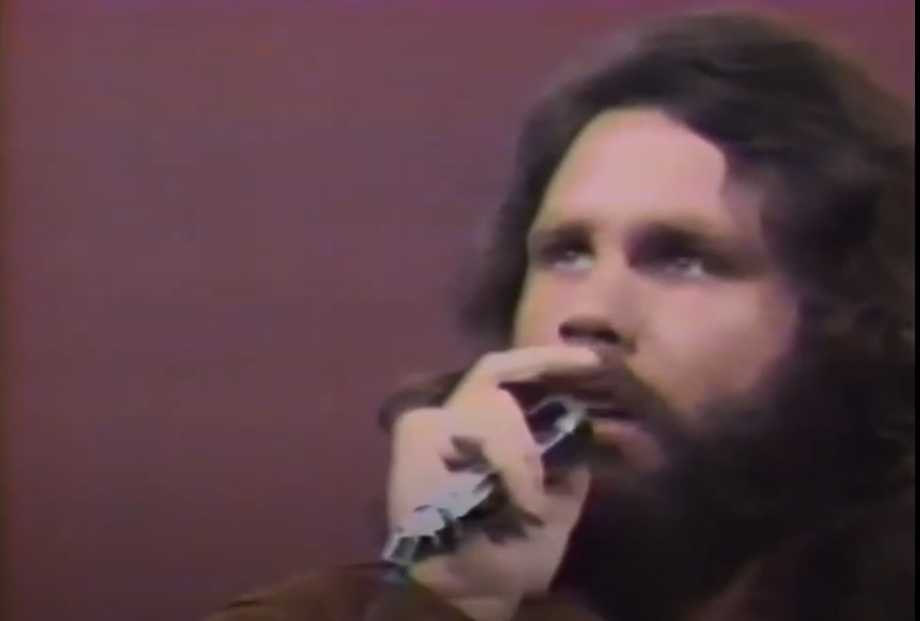
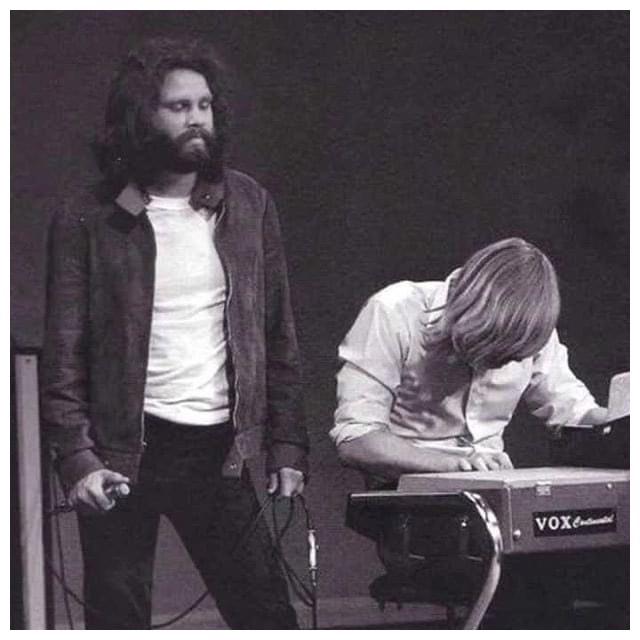

Nor does Jim sing like he’s on Quaaludes. If I recall correctly, the Critique performance was their first appearance after the Miami incident, and they rocked!
Watch the Critique performance.
Davis quoted Jim as saying in the Critique interview, “Asked what he wanted to do next, Jim’s hesitant answer spoke volumes about his aspirations: “I’d like to do a song, or a piece of music, that’s just a pure expression of . . . ah . . . joy.” [snipped]
Jim didn’t say that in the Critique interview, he said it in a documentary/performance piece “The Doors are Open”. Here he is saying it and you can see he looks nothing like he did in the Critique performance:


There are plenty of instances where Jim performed completely fucked up, but the Critique performance was not one of them. In the interview after their performance, Jim seems really low, like he did some downers, but not the performance. Davis wrote about the interview, “Ray and John did most of the talking. Jim only spoke when prompted by Ray.” That’s completely false.
Not sure why Davis portrayed the Critique performance and interview so erroneously.
Critique interview on youtube.
I’m not going to repeat what Davis wrote about Jim’s sexuality. It could be true, but as the info exists now, it has the feel of “I heard from my friend’s babysitter who also babysits for the Smiths across the street and every night they [unsubstantiated gossip/unverified rumors]”.
My personal opinion is that Jim did whatever the hell he wanted regardless of other people's opinions. If he wanted to be gay, he would've been gay.
I would love to read the Max Fink transcript and learn more about Max, but until then repeating what Davis repeats of Fink’s transcript (or what Davis repackages what Patricia Butler wrote) would be just propagating what I’m complaining about - info that seems like it was written about to sell books. It may all be true and I have no problem if Jim did gay stuff, was bisexual or was a closeted gay.
As with all things involving The Doors narrative I only want to know the truth. I’ve written an article that is about people who knew Jim and what they had to say about his sexuality: was-jim-morrison-gay-or-bi-sexual
The final push that had me buy Davis book was this quote of Jim’s I found online, “For me, it was never really an ‘act,’ those so-called performances. It was a life-and-death thing, an attempt to communicate, to involve many people in a private world of thought.”
What a statement!
I wanted to read more of that interview. I searched online for the source, but did not find it except for it’s use in Davis book. So I bought the book. The quote occurs thusly, “In an interview with the L.A. Free Press, Jim… said: “For me, it was never really an ‘act,’ those so-called performances. It was a life-and-death thing, an attempt to communicate, to involve many people in a private world of thought.”
I’ve searched all the L.A. Free Press articles but I haven’t found it. Figures. I’ll keep searching.
Following are some excerpts from an insightful review of Jim Morrison: Life, Death, Legend by theglobeandmail.com
While the book has many merits... much of what Davis reports in the early going is based on hearsay, speculation and supposition, and the book contains so many possiblys and maybes and perhapses that it all tends to cast Davis's research into question.
For example, we learn early on (though I'm not sure we really needed to know) that, as a child, Morrison was a bed wetter, a condition for which his mother had no patience. Davis then speculates that the bedwetting "may have been connected to a childhood bout with rheumatic fever" and that "this illness might have, additionally, weakened Jimmy's heart." As Morrison died at the age of 27, this could be seen as a crucial contributing factor, but no evidence is presented to back up the contention.
Davis introduces the concept of child molestation early on, reporting that Morrison had hinted to his attorney, Max Fink, that he had been "molested by a man when he was a boy." Davis mutes the allegations somewhat by introducing the story with the phrase, "If Jim Morrison's lawyer is to be believed," which undermines the credibility of whole thing.
The biggest bombshell of all is reserved for what Davis hints at were Morrison's homosexual experimentations, but again, no hard proof is given.
At one point, Davis relates the story that Jim had told Max Fink, that he had been intimately involved with a man during his junior college days. The man was a club owner named Tom Reese, who, when questioned about the incident years later, would neither confirm nor deny the allegations. "Well, let's put it this way," Reese said. "Everyone wanted to." Later, Davis relates rumours about Morrison's disappearances when the band wasn't working. He was "said to be holed up with some gay friends at a ranch in Topanga Canyon." Again, lots of allegations, no real proof.
Perhaps Davis himself was not even aware of the large number of unproved theories he was putting forward. Perhaps he included the gossip and innuendo and suppositions that he did simply in an attempt to tell the whole story. Perhaps he simply bought into the rumours because his research led him to believe that all of it was true. But it seems odd that a proven biographer could so thoughtlessly and effortlessly give credence to every wispy theory imaginable concerning a man who can't even respond to the allegations.
A work of this magnitude should be about truth, not simply speculation. Otherwise, why bother?


